

Saturday morning I opened Claude on my phone to use Fable for something, and it was gone.
My first thought certainly wasn’t a big one. It was “did I accidentally unsubscribe?” or do something wrong?
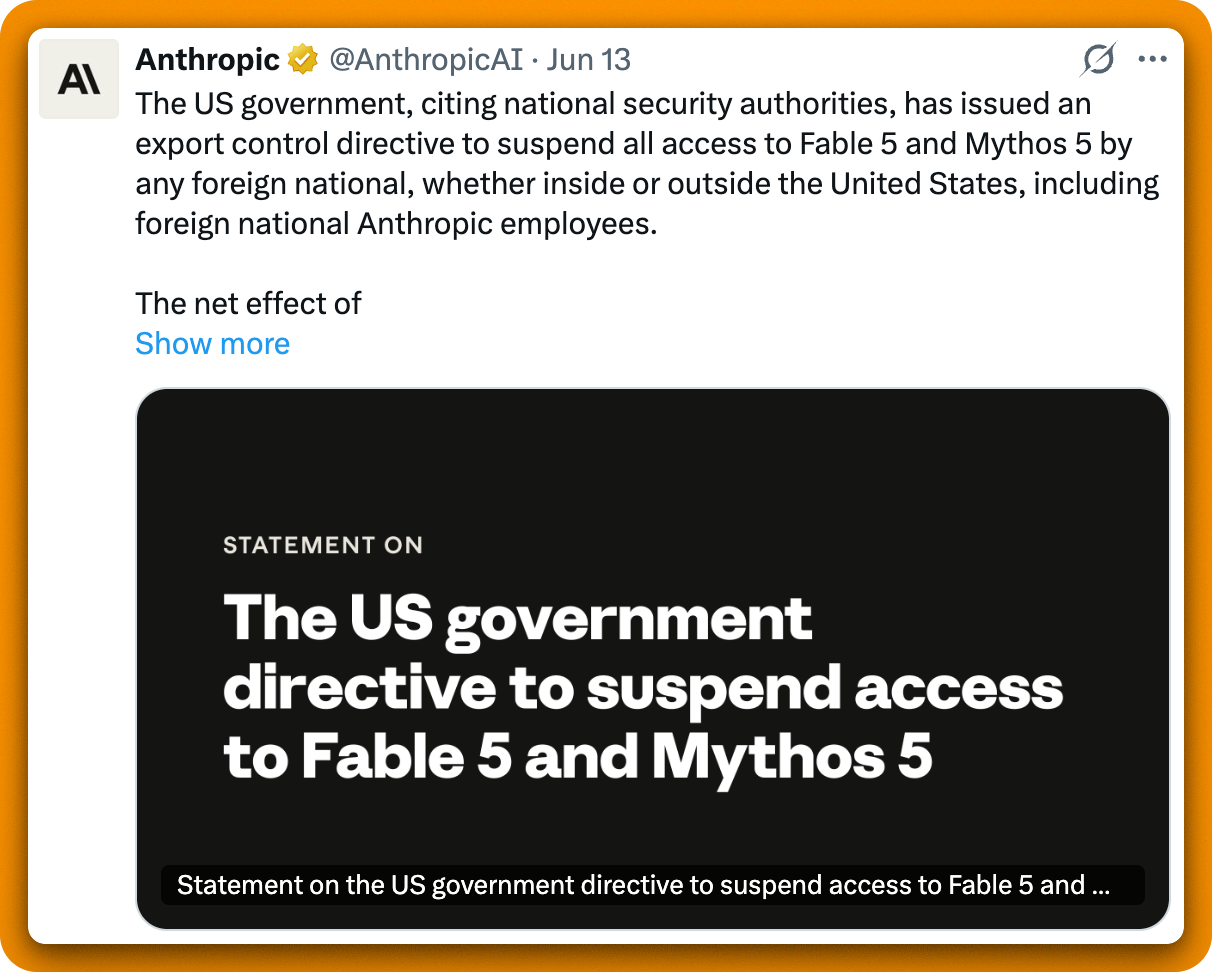
So I checked my Anthropic account. Nothing wrong. Then I did what you do -- went to X to see if it was just me. And there was the notice: the US government had asked Anthropic to press pause on Fable.
My very next thought was: damn, I hadn’t finished the work I’d lined up with Fable. Our website. A free tools site build. A pile of things it had been quietly unlocking for me all week.
It’s Monday now, and I’m honestly not sure I’ll get through that work as fast, or with as much confidence, as I would have on Friday.
That’s part of the fun of all this, I suppose.
Locked in?
We got lucky, mostly. We’re not 100% locked into any one model, and none of our workflows are tied to a specific one -- we can swap an Anthropic model for an OpenAI one pretty painlessly. So in one sense, nothing broke.
But it rattled something loose. Are we actually planning for this?
Short answer: nope. The risk I’d been managing turned out to be oply one of the things to consider.
I’d been thinking only about cost. Token crunch, prices creep up, how do we absorb it, how much margin do we hand back. That’s a commercial risk, and commercial risk is the comfortable kind -- how you respond to growing costs is in your control. You’ve got levers. Pricing. Margin. You can model it on a spreadsheet.
What I hadn’t been thinking about is availability and continuity. What happens when a model just goes away, and not over a price you can negotiate, but because of a decision you had no part in?
That risk is out of your hands. The only thing in your hands is whether you did any insurance thinking ahead of time. I hadn’t. The question I couldn’t answer Saturday: if we entirely lost access to frontier models, do we know what we’d do? Again, short answer: nope.
It’s nothing new
Tools going away is nothing new -- they get acquired and shut down, sunset, quietly killed. Usually there’s an alternative and it means a migration headache, not a funeral.
A model feels different because it’s baked into how you work. Except, like I said, for us the model itself isn’t. Swapping vendors is easy.
So the lock-in wasn’t the vendor, but the category. It’s the assumption that frontier AI will simply always be there in the same way we assume the internet is always there.
Picture going all-in on the internet to run your business, and then having it taken away. That’s the dependency I’d stopped seeing. And it gets deeper every time you wire up another agent to do real work, important work on a schedule.
I don’t have a tidy answer yet, and we’ll keep using frontier models -- you have to, that isn’t the lesson. The lesson is smaller and more annoying: I’d stopped looking.
So here’s the one thing I’m doing this week. Taking 30 minutes to look at important workflows from across the copmany (product, engineering, go-to-market, sales ops, etc.) and drawing a quick exposure map.
Where are the dependencies we hadn’t thought about? What happens if it doubles in price, or disappears? I don’t think everything will need an immediate fix, but it’s important to see the dependencies and possible gaps.
From there, we can plan for insurance or fallbacks.
The worst dependencies aren’t the ones we choose. If there’s a clear decision to go “all-in” on a tool, it’s usually with eyes wide open.
The dependencies that sting are the ones we just walk into, assuming that everything will just keep working.
Time to take stock of how dependent we are on LLMs and those big frontier companies.
Peter
PS: This isn’t the first time (or the last) platform dependence matters. It’s just the latest. And maybe because it’s AI it feels bigger?