

The foundation of retention work is understanding where you’re at now, getting your data and signals in order. As boring as it sounds on its face, the data layer unlocks the fun bits.
And while building that data layer is internal, the next steps run straight into your customers where it all starts to get real. Yeehaw.
Go-to-market gets all the love on the socials. Look at LinkedIn for longer than a sneeze and you’ll see systems-maxxing everywhere.
Workflows and enrichment and tooling all leading towards pipeline. Sales. And that’s where it stops.
Thankfully, with our constraints in mind and our customers at the center of our attention, we can build cool sh*t just like the GTM teams.
In fact, because those constraints narrow the options of what we can build it’s actually easier to get started and it forces real creative thinking.
Signals and systems
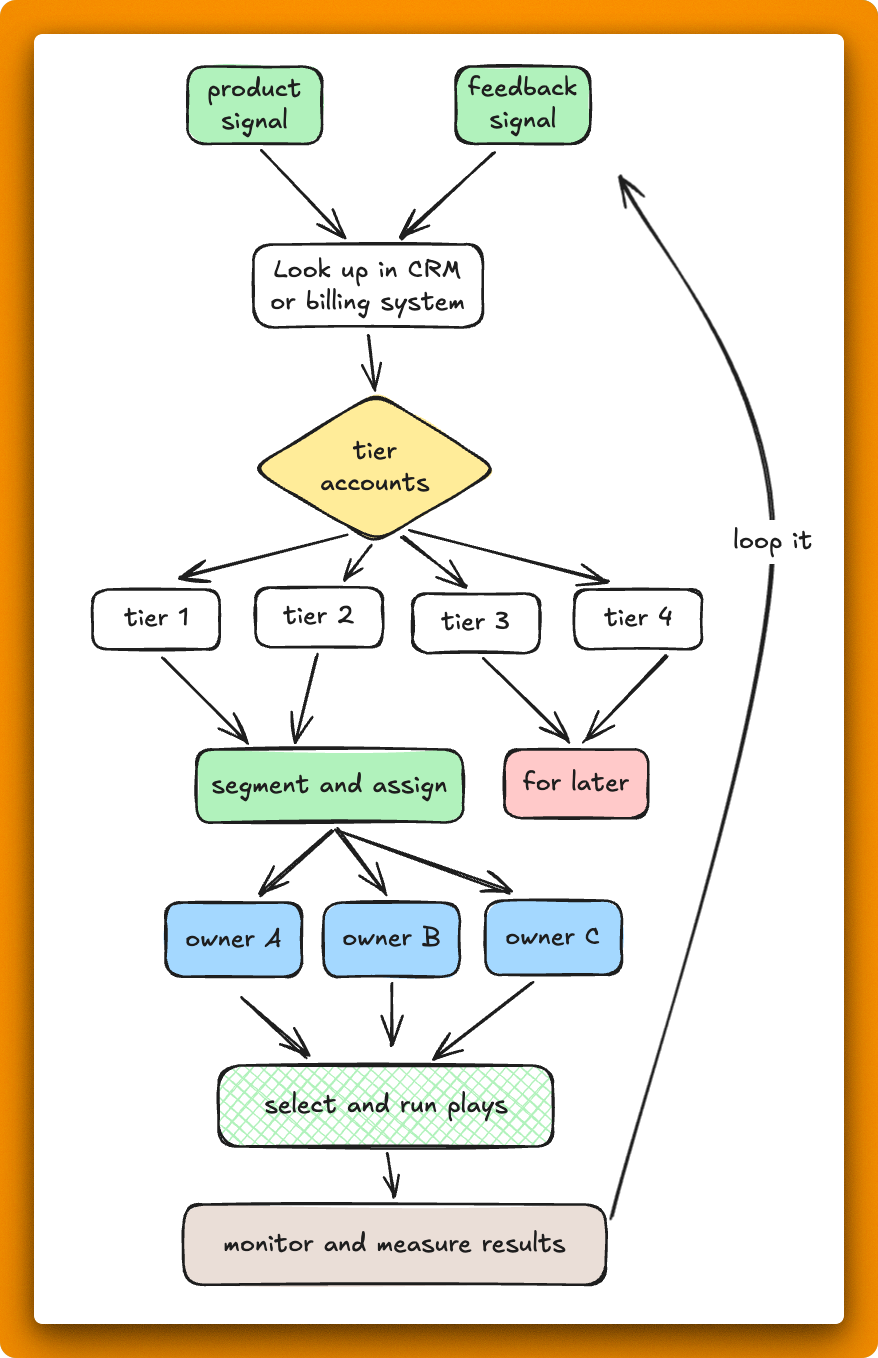
With your data layer ready, you have signals you can use to trigger fun new workflows aimed not at landing new deals, but at keeping customers happier for longer.
You’re now building for metrics like Net Revenue Retention (NRR), Gross Revenue Retention (GRR), and churn 👻.
This is valuable work if you like the idea of growing your business without needing to constantly chase new logos.
It’ll impress investors. It’ll impress acquirers. It’ll help you sleep better.
Start simple
Pick one or two signals to start with. Build hypotheses around them. Dream up ways to prove your hypothesis right (or wrong).
Pick something quantitative and/or qualitative. Doesn’t matter so long as it’s clear that the purpose of this work is to:
Help customer get more value from your product
Increase the LTV of select customers
Give your business real revenue momentum
Signals can be things like:
Product engagement dropping
Big new account isn’t hitting activation thresholds fast enough
Your Buyer Champion told you she’s leaving for another company
Not all customers are created equal
Once you choose your signals, tier your customers. Prioritize them by value to the bottom line and the continuity of your business.
Almost everyone stumbles at this at least once. I’ve done it countless times — spent too much time on $20/month customers while a $2,000/month customer slips away. Tier your customers so you spend more time for now on the most valuable.
When you’re deliberate about working on your most valuable customers first (Tiers 1 & 2), you will get to build systems for every size customer. That’s because when the big $$ customer base is more stable, you have the freedom to work on the more volatile little ones (Tiers 3 & 4).
Assign owners and let them cook
Don’t let a committee run this. Assign each Tier 1 & 2 account to a someone. Let them cook up ways to solve the problems.
Then give them the space to run experiments, monitor results, and feed that back to the rest of the team so the whole system can get better.
Capture what works and what doesn’t work. With AI now it’s getting easier to build this institutional memory so your system almost self-improves. That’s an entirely different topic, though.
The outcomes of the walking stage
For now, this is still the walking stage. We’re after learnings we can amplify later.
Plays can and probably should be run by hand. Let the humans take the signals, come up with the plans, email and message customers directly.
Get more than one positive outcome from the system before thinking about upping the pace. Running feels good until you realize you just ran a half-marathon in the wrong direction.
The drawing above is a bit simple, but it can be all you need to start building retention muscle. If you know you want to start keeping customers longer, but aren’t sure where to start, hit reply and we’ll jam on it together.
Next up, things get complicated quickly when you start to run. It’s wicked exciting.
In Customers We Trust,
Peter